
12 May 2026 ● Jobs Go Public
Public sector job security: what the UK data shows
Job security has been on more people’s minds lately, and for good reason.
The Office for National Statistics (ONS) shows UK vacancy levels since May 2025 have been hovering at their lowest since the pandemic. Employers are pulling back on hiring, and the question “will this next job actually stick?” is a huge point of concern for job seekers.
If that’s where you are right now, you’re not the only one asking the question.
The public sector has a long-standing reputation as being a safer bet for job security. But reputation isn’t the same as evidence, especially if you’ve seen headlines lately about civil service cuts or local government reorganisation.
So we’ve gone to the data instead to show you how public sector security stands up to the private sector, what protections you can count on, and how the picture differs between sub-sectors.
Are public sector jobs really secure?
The short answer is yes, the public sector offers more job security, by most measures.
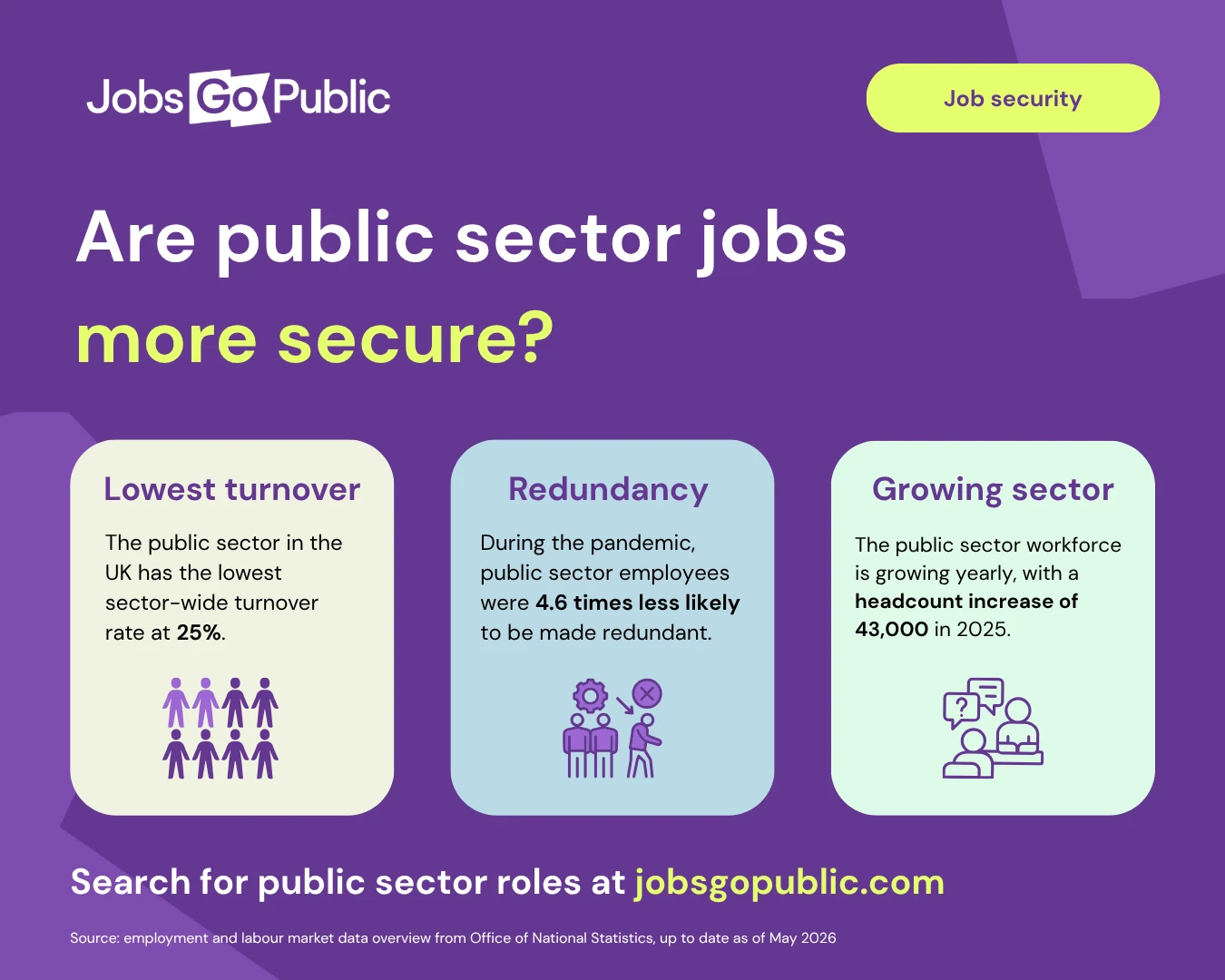
Public administration has the lowest staff turnover of any major UK job sector, at around 25%. This is compared to an average of 34% across the UK in general, according to the CIPD.
Redundancy rates have also historically been the lowest of any sector too. During the pandemic when the UK redundancy rate hit 14.2 in 1,000 employees, the public sector sat at just 3.3 in 1,000 employees.
What’s more, public sector employers, unlike private companies, can’t just go insolvent and shut down operations due to running out of money.
Overall, the public sector is growing. ONS employment data from December 2025 shows the UK public sector workforce has increased by 43,000 staff year-on-year.
That said, it’s important not to consider the public sector as a single mass. Security looks different in central government than it does in a council or a school. The picture has also started to shift in some sub-sectors in 2026.
So the honest answer is: yes, public sector roles are generally more secure than private sector ones. But where you’re applying also matters.
What job security looks like in the public sector
Job security in the public sector is built in through structural protections that are often lacking in private sector roles.
Here are some of the cultural differences you might notice in a public sector organisation:
Voluntary exit before compulsory redundancy
When public sector employers do need to reduce headcount, they overwhelmingly opt to do it through voluntary routes. The National Audit Office reports that of the 730 civil servants who left under exit schemes in 2024-25, just 35 staff (5%) went through compulsory redundancy.
The reason voluntary routes dominate is partly because the terms are better. Voluntary exit packages can pay up to 21 months’ salary, versus a 12-month cap for compulsory redundancy. What’s more, as we explored on our blog about local government reorganisation, voluntary exit can include early access to your pension.
These terms give staff peace of mind, offering a financial guarantee in the event you need to look for further work.
Continuity of service across employers
If you move between qualifying public sector employers (e.g. local government employers), your length of service follows you.
This gives you continuity with your redundancy entitlement and pension accrual. Private sector workers typically start from zero each time they switch employers.
It is worth noting that this isn’t a guarantee for any individual role. However, the odds of benefitting from this peace of mind in the public sector are significantly higher.
What happens to jobs during council reorganisations?
Check out our guide on council jobs and how they will be impacted by the local government reorganisation programme in England.
Strong union recognition
Most public sector roles sit under recognised trade unions such as UNISON, GMB, or Unite. This offers formal collective bargaining rights and the right to be consulted on workforce changes.
This means decisions about redundancies, restructures, and changes to terms and conditions can’t happen without notice. Unions are involved from the proposal stage, and any collective redundancy of over 20 staff requires formal consultation.
Union recognition is far less consistent across the private sector.
Employers that are driven by purpose
Public sector employers exist to deliver services that aren't going anywhere. Children always need teaching, bins need collecting, and councils need running.
That means workforce planning considers statutory service obligations and multi-year budgets, not quarterly results or shifting market conditions.
The kind of sudden strategic restructure that can hit private sector workers (e.g. a company takeover, or cost-cutting drive) is structurally much less likely.
If you’re weighing what it’s actually like to work in the public sector versus the private sector, our moving to the public sector guide goes into more detail.
How job security looks across different parts of the public sector
The public sector is a broad and varied area, covering everything from a government policy department to a multi-academy trust. The structural protections we’ve explored apply across most of the sector, but individual experiences vary depending on who your employer is.
Here’s a breakdown of some of the major sub-sectors.
Civil Service
The Civil Service employed 549,660 people as of 2025.
Departments in the Civil Service are currently in a period of active workforce change. Due to restructure, over 8,500 civil servants are expected to leave via voluntary exit schemes by March 2027.
While this represents a headcount reduction, the focus remains on choice. Voluntary exit schemes offer generous terms for those looking to move on, while protecting the roles of those who remain.
Moreover, our analysis of over 13,000 job adverts on Jobs Go Public between February and May 2026 found that 68% of central government adverts reference internal redeployment processes.
The emphasis on redeployment demonstrates a commitment to keeping talent within the government, rather than traditional redundancy.
Local government
Council staff across the UK numbered around 1.16 million in the latest workforce summary from the Local Government Association.
Despite the headlines, job security in local government is steadier than it looks. Much of the 'shrinking' workforce over the last decade is actually just reclassification, like school employment moving to academies, rather than council roles being axed.
When budgets do get tight, councils don't just cut and run. They use structured frameworks that prioritise voluntary exit schemes and redeployment.
It’s a system designed to treat redundancy as the absolute last resort, keeping the focus on stability even during a restructure.
State education
State school teaching is currently a sector the government is actively trying to grow. The government has set a target to expand the teaching workforce by 6,500 as part of its Plan for Change.
This is a particularly important challenge given the fact that the National Foundation for Educational Research (NFER) finds the leaving rate for early career teachers is particularly high. In their 2025 report, they reviewed data that shows around one-fifth of newly qualified teachers between 2014 and 2017 had left teaching within two years.
This demonstrates a strength for job security: schools are experiencing skill shortages rather than a need to cut staff. What’s more, retention for the experienced workforce is improving year-on-year, with 91% of teachers remaining in state-funded education as of 2025.
While pressure on the sector remains a challenge for employers trying to attract teaching talent, these trends show a stabilisation of the education sector in recent years. With a growing demand for staff, teaching roles are not going anywhere.
Social housing
The housing sector is in the middle of an unusually strong period for investment.
The June 2025 Spending Review committed £39 billion to social housing over the next decade, doubling previous levels. This is alongside an upskilling programme designed to grow the housing workforce.
The sector is also experiencing changes in regulations which benefit housing careers. From October 2026, new conduct standards for social housing staff will come into effect.
These will provide more structured career paths, recognised qualifications, and progression routes. If staff transfer due to housing stock moving between providers, TUPE protections will also preserve their employment contract terms.
How to assess a role’s security before applying
Even within the public sector, some adverts give you more confidence than others.
Based on our analysis of adverts on Jobs Go Public between February and May 2026, here are five things worth checking before you apply.
1 Look for the contract type, not just the role title
Check that the employer has posted the role as a permanent position, rather than as a temporary contract or cover role.
If you can’t find this listed in the advert, it could be worth a quick email to the recruiting team. Many employers on Jobs Go Public include a point of contact for informal discussions about their vacancy.
2 Check the purpose of the role
Assess the vacancy for why the employer is hiring. Is it part of a scheme or an employer initiative? If so, does the vacancy go into any more details about progression opportunities or how your role contributes to the wider team?
Strong signs about how this role fits into the longer-term strategy of the team suggest the employer is invested in the role, not just filling an immediate gap.
3 Scan the job advert for redeployment language
68% of central government adverts we analysed referenced internal redeployment processes. This includes language like "internal mobility", "career pathways" or formal restructure protections.
These are signals about how the employer manages workforce change, and adverts that include them are telling you that even if your role could change, your employment is secure.
4 Evaluate who is advertising the role
Is the job posted by a direct employer like a central government department, or is it being advertised by an agency? Contract and agency roles may offer short-term boosts in pay, but often come with much less security, as they are usually the first roles cut.
Many of our employers are pushing towards moving contracted staff to more permanent positions. These also typically offer better benefits packages. You can browse Jobs Go Public to find permanent positions, and rest assured that we only work with direct employers.
5 Monitor the employer’s reorganisation history
If an organisation has recently experienced a reorganisation project in the last few years, this can be a positive indicator that the workforce structure is stable for the time being, providing no other financial emergencies arise. However, if they haven’t looked at the workforce structure in a decade, they could be due for a big change.
Our employers are open about these changes. For example, Surrey County Council explicitly mentions local government reorganisation in their recruitment advertising, and offers reassurance about how roles are protected during the project.
The bottom line on public sector job security
Job security is never a guarantee – no role comes without its trade-offs. Plus, which part of the public sector you work for also plays a role. But the data backs up the public sector’s reputation.
Lower turnover, redundancy rates, voluntary exit options, union representation, and organisational resilience offer protections that are rare in the private sector.
In an uncertain labour market with high competition for applications, “is my next job actually going to last?” is a fair question to ask yourself. The public sector is one of the few places where you can answer it with confidence.
Thinking about making the move? Get started today with a job search on Jobs Go Public. You can start applying for roles right away, or save job alerts straight to your inbox.
About Jobs Go Public
Jobs Go Public is the UK's specialist job board for the public and not-for-profit sectors. Operating since 1999, we work exclusively with employers across local government, central government, social housing, education and the charity sector.
We use our vacancies, candidate research, and ongoing employer relationships to bring readers original analysis on the public sector labour market.