16 Feb 2026 ● Jobs Go Public
Why 57% of candidates abandon applications in the public sector
Have you ever been looking to buy something online and given up because the company just made it too difficult?
The e-commerce world refers to this as “shopping cart abandonment”, and any self-respecting online retailer is constantly looking to prevent it.
In recruitment we face a similar challenge – how do we prevent job application abandonment? At every step of the hiring process, a candidate has the choice to continue applying or give up and go elsewhere.
As job application technology evolves with AI tools and social media integration, attention spans continue to drop. And in a highly competitive and noisy job market, everyone’s fighting for the best people.
We’ve surveyed thousands of job seekers over the past few years as part of our candidate experience research. Here’s what we found out about why candidates drop out:
1. Candidates abandon poorly written job adverts
Your job posting is the first hurdle in the hiring journey, and the point where you will lose the most candidates.
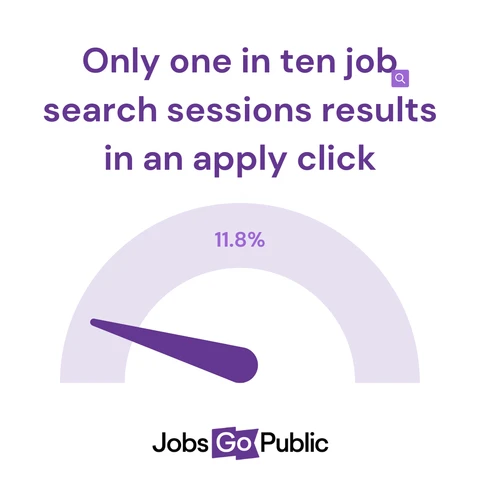
Over the last 6 months, job seekers on Jobs Go Public showed a view-to-apply rate of 11.8%. This means just over 1 in 10 job board sessions result in a user applying for a job.
Can you afford to lose more relevant candidates from this pool because of a poorly written advert?
It’s important to note this isn’t a cause for alarm. There can be some positive reasons why a job advert might deter a candidate from applying.
A well-crafted job posting gives candidates a clear insight into your opportunity and organisation. This helps to sift out poor-quality candidates before shortlisting even begins. You don’t want to be wasting extra time rejecting applicants because your job ad was too vague to attract appropriate candidates!
However, if you’re losing candidates for the wrong reasons, then you have a real problem. You could be losing rare candidates that are perfect for a hard-to-fill role.
In local government, this could be the difference between someone working for you instead of your neighbour.
How to attract more candidates with your job posting
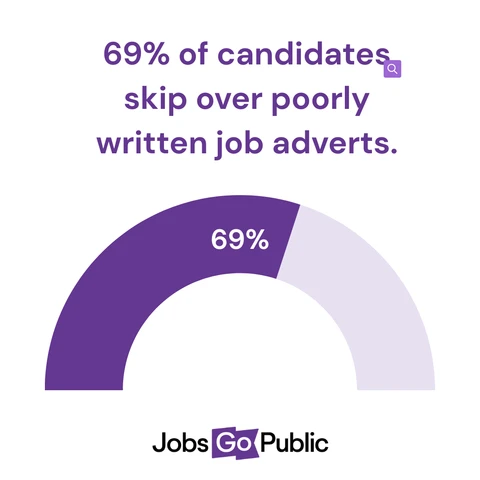
From a pool of over 1,700 job seekers in 2024, we found that 69% of candidates would abandon a job posting before clicking apply because the advert was poorly written.
When your advert is one of the first steps on a candidate’s journey, then you need to ensure it makes the best first impression.
Taking time to check that all spelling and grammar is correct, information is accessible, and the formatting is optimal makes all the difference.
Want to create job ads that get results?
Get tips on crafting a top-tier job advert that stands out from your competitors.
Make sure your vacancies are transparent
Among respondents, a key theme of candidate engagement was transparency. Examples of problems job seekers often encounter are:
- Employers stating “competitive salary” instead of an actual figure.
- Hiring managers not highlighting the expected dates for shortlisting or interviews.
- No clear guidelines on how to apply for a role.
- No contact details for candidates to have a casual discussion about the role.
We frequently see a clear divide on our job board between job seeker expectations and the reality of the job ads employers post. Including the information candidates expect to see will ensure that you stand out from the crowd and reduce your job posting abandonment.
Are your job ads accessible?
Accessibility is an important element of candidate experience. Without it, you’re missing out on a more diverse pool of applicants who have the correct skills for your role.
At Jobs Go Public we’re big advocates for accessibility, creating WCAG compliant application forms and integrating Recite Me’s toolbar with our job board. However, as a hiring manager you can also improve the accessibility of your job postings through how you write them.
Netizens (online citizens) have increasingly shorter attention spans when using digital tools. An analysis by online user experience experts, Nielsen Norman Group, suggests that users only read 20% of the text on a webpage.
This means your job postings need to be easy to scan and understand quickly before a user moves onto the next listing.
Common sources of frustration in our whitepaper surveys in 2024 and 2025 for job ads included:
- Vague job adverts that don’t explain the role properly.
- Long shopping lists of responsibilities.
- Lots of complex sentences.
- Jargon that is only used by your organisation.
Read your job posting draft back after writing and try to put yourself in the candidate’s shoes. Is it easy to read? Could an AI chatbot like Copilot help you restructure your text to make it more accessible?
Ensuring your job postings are transparent and accessible is an easy way to improve the application rate without investing more time and money into attraction methods.
Not sure how to structure your job adverts? Our template could help! Download your free editable job template here.

2. Job seekers abandon application forms that are complicated
Studies continue to show that jobseekers prefer quick and easy application methods, with most wanting to quickly submit a CV online.
Difficult application forms have a high abandonment rate. In our own research on candidate experience, 57% of job seekers stated they would abandon an application form if it's too complex.
What’s more, the web is increasingly moving to a mobile-friendly experience. Just under two-thirds of Jobs Go Public users in the last 6 months browsed jobs on their mobiles.
Even with a stellar advert, this means you’ll still lose most of the candidates who click apply if your application form isn't user-friendly.
Many clients speak to us about struggling to get candidates to complete their applications yet are often still using outdated and clunky forms.
If you’re seeing a lot of apply clicks but not many completed applications, then take a close look at your application process.
It’s important to streamline the touchpoints in a candidate’s journey to keep quality applications on track.
How can you stop candidates from abandoning your application form?
In 2024 when we asked over 2000 candidates why the quit applications, here’s what they said:
- 23% abandon applications when there are too many unnecessary questions.
- 22% give up when there’s no option to save their progress and come back later.
- 19% quit if the form is longer than they expected.
18% will simply give up if they’ve found other vacancies with an easier process.
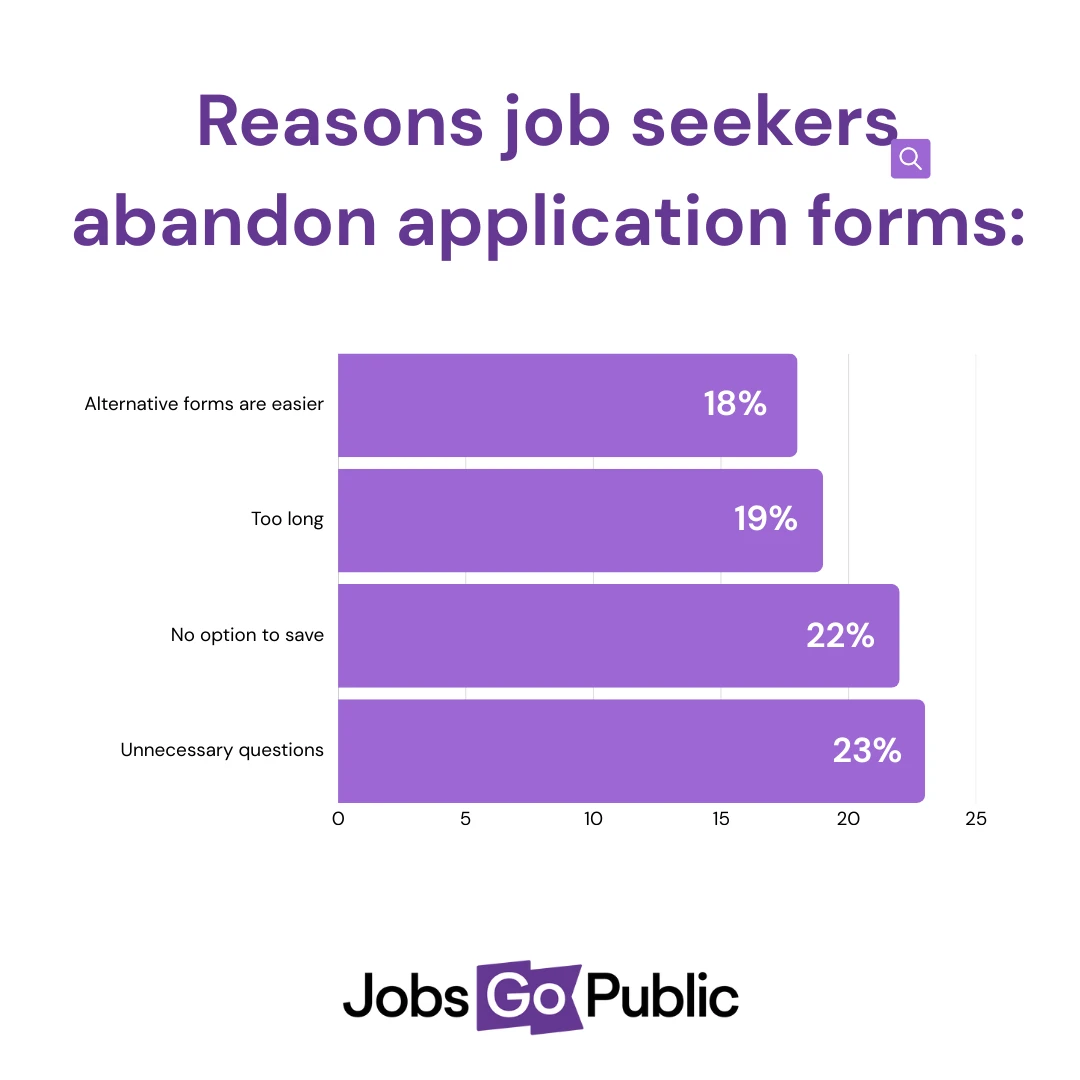
These statistics show a brutal reality. Candidates are increasingly impatient when it comes to applying for roles. This is no surprise when many job seekers on forums like Reddit report applying to dozens of roles a week due to the difficult recruitment landscape.
The 15-minute application form threshold
Our research suggests that public sector candidates are willing to spend up to around 50 minutes on an application form – but only if the questions feel relevant and the process is smooth.
And that’s generous. Research by Greenhouse suggests that the maximum time job seekers will spend applying before giving up is just 15 minutes. If your form takes an hour, you're losing candidates before they finish.
Put your candidate hat on and ask yourself the following questions:
- Is my form simple and efficient?
- Is the form digital and easy to submit online?
- How long would it take me to complete if I did it myself?
- Can I get any of the information I am asking for from the candidate’s CV?
- Is the application accessible to disabled jobseekers and those who speak English as a Second Language (ESL)?
To get ahead of competing employers, you should also consider common pain points raised by jobseekers when they’re applying for public sector jobs:
- Employers often ask candidates to manually list qualifications and experience that’s already in their CV.
- Applications that ask for long supporting statements and free-text answers aren’t needed for all roles and can be difficult for candidates to fill in without turning to AI chatbots.
- Employers often don’t proofread or test their applications before asking candidates to fill them in, leading to a poor impression of your employer brand.
- Standardised forms can be guilty of asking candidates to fill in questions that are irrelevant to the job description.
For those of you that do have an online application form, this isn’t the final piece of the puzzle. You need to test every aspect of your form to ensure that it’s functional.
There’s nothing more frustrating for a candidate who’s spent time and effort applying for a job than not being able to complete the process fully.
Why public sector vacancies go missing (and how to solve it)
Find out why job classification is key to attracting the right applicants.
3. Applicants abandon hiring managers with poor communication
Many people think that once the applications are in, the work is done. Then it’s just a matter of shortlisting and the interview process, right?
It isn’t quite that simple.
Always remember that active candidates are almost certainly applying for other roles, and therefore, your competition for quality talent is still far from over.
The more candidates know about what to expect moving forward, the more likely they are to stick with you through it.
The application doesn't end when candidates click submit. In 2025, 2,367 job seekers revealed what happens next matters just as much:
- 16% are put off by unprofessional communication from hiring managers.
- 14% lose interest due to poor response times.
- 12% disengage when there's no information about benefits or culture.
And there's a hard deadline: candidates told us they'll wait a maximum of 3.36 weeks between application submission and interview invite. After that, they've mentally moved on - even if they haven't formally withdrawn.
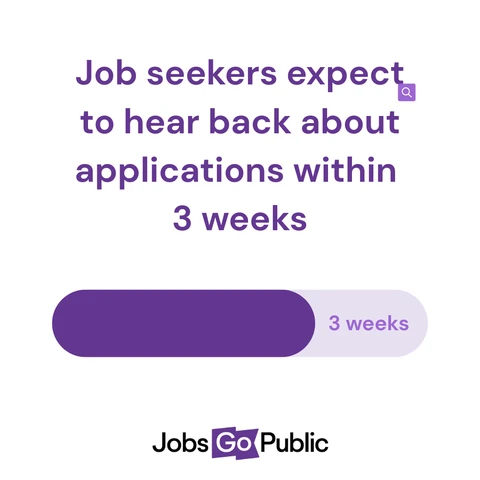
Provide applicants with any information you have about the process, including how long you expect each stage to take. This avoids a situation where good candidates might accept another offer due to waiting a long time to hear from you.
This doesn’t mean that you must rush through your recruitment process. You just need to keep candidates updated and in the know with a quick email. You can usually do this through your Applicant Tracking System.
You may be tempted to wait until the close date of a vacancy to contact candidates. But it never hurts to drop an acknowledgement to your early applicants about your shortlisting timeline.
Moreover, if you’ve been delayed at any point, send an email to inform your applicants that they’re still in consideration. This can go a long way to keeping more candidates in your pipeline.
Optimise your recruitment process so you don’t lose job applicants
Attracting and holding onto quality candidates doesn’t need to be a challenge.
Our survey data is clear: transparency, simplicity, and communication are the three pillars of an application process that converts into shortlisted candidates.
Going back to the comparison with online shopping, think about a retail platform like Amazon when looking at your recruitment process.
Generally, product pages have a lot of information about what you’re buying, and it’s easy to access. The buying process is quick and painless (often with a single click of a button), and they keep you informed about when you can expect your purchase to be delivered.
If you can get your recruitment process to emulate this model, you’ll likely find that your application numbers begin to rise.
Written by Jobs Go Public
Jobs Go Public is a job board specialising in public sector recruitment. We’ve been helping employers in local and central government, education, and charities attract candidates since 1999.
Last updated: 20th April 2026
Optimise your candidate experience
Get your free checklist to keep candidates in your application pipeline