23 Feb 2026 ● Jobs Go Public
Work-Life balance in the public sector: what our jobs show
If you're thinking about a career change, or just questioning whether the grass can be greener, work and life balance is probably high on your list. It's one of the biggest reasons people consider moving from private to public sector, and one of the most common things candidates ask us about.
But what is employee wellbeing beyond a buzzword in a job advert? And does the public sector really offer a healthy work-life balance, or is it just a recruitment line?
We reviewed over 3,000 live public sector job listings on Jobs Go Public. We looked at what employers offer, like flexible working arrangements, annual leave, pensions, and mental health support.
The results paint a clear picture.
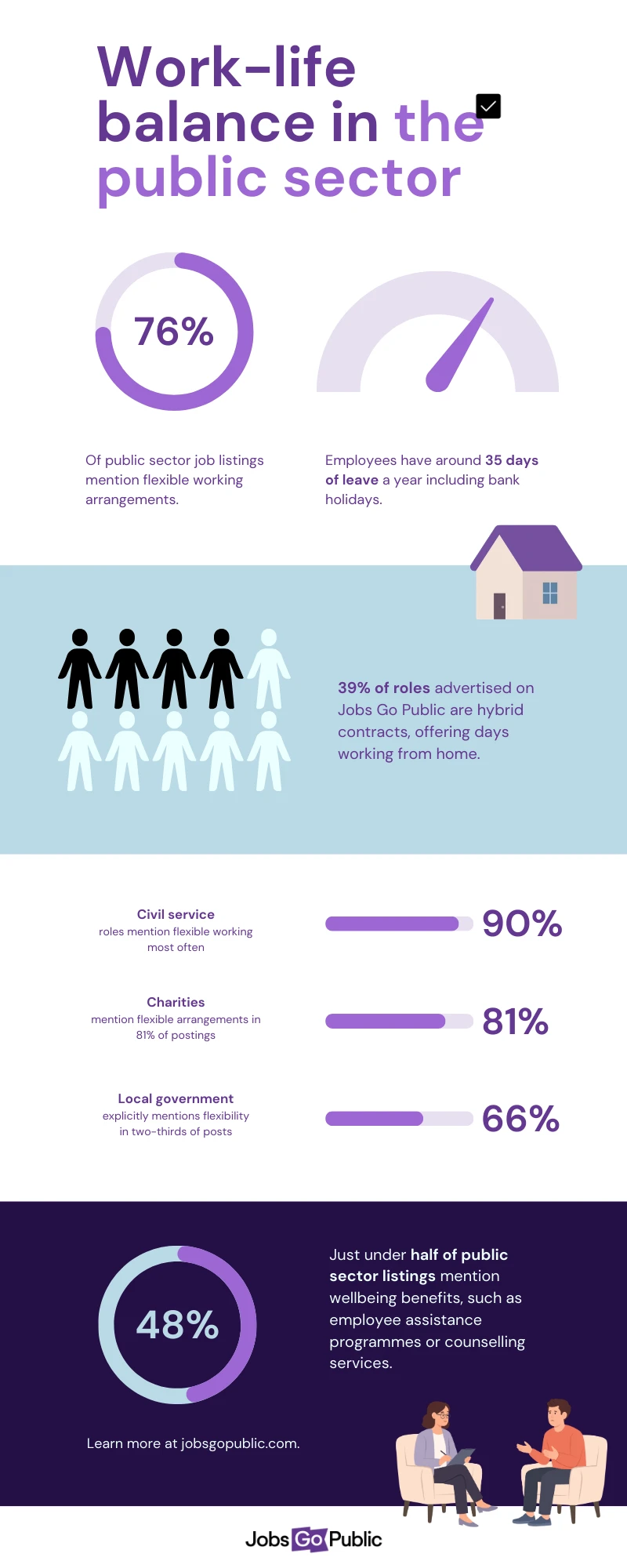
Over three-quarters of roles mention some form of flexible working and the average annual leave entitlement is around 35 days (including bank holidays).
Whether you're weighing up public vs private sector for the first time or seriously planning a move, here's what the data shows.
What makes public sector jobs some of the best careers for work-life balance?
When people talk about jobs with great work-life balance, public sector roles come up time and again. But it's not just a matter of reputation. These roles consistently deliver on that promise.
Contracted hours that mean what they say
One of the biggest advantages of public sector work is that a 37-hour week actually means 37 hours. Across the 3,000+ listings we analysed, the most common contracted hours were 37 per week. The median was also 37 across all subsectors.
That might not sound revolutionary. But if you’ve come from a private sector role where 37.5 on paper means 50 in practice, the difference is huge.
Local government roles typically advertise 35-37 hours per week. Charities and housing associations offer even greater balance at around 35-37.5 hours.
Annual leave that goes beyond the minimum
Public sector employers don't just meet the statutory minimum. Most go well beyond it. From our data, the average leave entitlement advertised is 27.7 days plus bank holidays. This gives most employees around 35-36 days of total paid leave per year.
Nearly a third of listings that state their entitlement offer more than 28 days before bank holidays. Many employers even increase this further based on length of service. Kingston Upon Thames, for example, advertises 25-32 days depending on grade and service.
When you add work hours and generous leave, it becomes clear why so many people value working in the public sector. These posts often offer a strong work-life balance, even before flexibility comes into the picture.
Benefits of flexible working: real examples from public sector employers
Flexible working has gone from being “nice-to-have” to a dealbreaker for job seekers. If you're seeking real work-life balance examples rather than vague promises, look at how public sector employers approach flexibility.
From our review of over 3,000 live listings, 76.2% mention some form of flexible working. That's over three in four roles where flexible work hours aren't an afterthought: it's part of the offer from the start.
What types of flexibility are on the table?
The benefits of flexible working in the public sector go well beyond working from home one day a week. Two-thirds of posts (65.5%) mention flexible working in general. However, many go even further by naming the specific arrangements they offer.
Here are some flexible working examples from employers on our board:
- A hybrid working environment is the most common workplace arrangement, appearing in 39% of roles.
- One in ten roles mentions job sharing: an option that's almost unheard of in the private sector.
- 5.6% advertise flexi-time, where you work core hours and flex your start and finish around them.
- 5.1% offer compressed hours, e.g. a four-day week on full-time pay
- 5.1% offer term-time only contracts, particularly in education roles
And these aren't just policies buried in a staff handbook. Employers are leading with them.
Birmingham Children's Trust, for example, describes itself as "well adapted to a hybrid model of working which includes a combination of time spent in the office and at home."
Knowsley Council spells it out clearly: "For most roles, the following types of flexibility are usually possible: flexible hours, working from home, compressed hours, part-time."
Where is flexibility strongest?
Not all sectors offer the same level of flexibility, so it's worth knowing where to look.
Civil Service departments lead the way, with 89.6% of roles mentioning flexible working. Charities aren't far behind at 81%, followed by local government at 66.4%.
Education roles tend to be lower, around 37-59%, which is largely because of classroom-based work.
Since April 2024, flexible working has been a day-one right across the UK. But what stands out about the public sector is that most employers were already there long before the legislation caught up.
Public vs private sector: how work-life balance actually compares
It's easy to make sweeping claims about the difference between public and private sector work. So rather than opinions, here's what the data tells us.
| Benefit | Public Sector | Private Sector |
| Average contracted hours | 37 hours | 38.5 hours |
| Average annual leave (before bank holidays) | 27.7 days | 25.9 days |
| % of job postings offering flexible working | 76.2% | 31% |
Public sector data from Jobs Go Public listing analysis (3,040 listings). Private sector data sourced from ONS, PeopleHR and Timewise.
The numbers tell a clear story, but some of the differences run deeper than they first appear.
Shorter contracted weeks add up
A difference of 1.5 hours per week might not sound like much. But it adds to almost 80 extra hours over a full year: roughly two extra working weeks.
Across our listings, the most common contracted week in local government is 37 hours. In civil service roles, it's typically 36-37 hours.
These are the hours employers expect you to work, not a starting point for negotiation.
Leave you can actually take
The gap here is nearly two full days before bank holidays are factored in. But it's not just the entitlement that differs, it's the culture around using it.
Public sector employers encourage staff to take all their holiday time. Many also increase allowances based on your length of service.
Wirral Metropolitan Borough Council, for example, advertises "an annual leave package starting with 28 days leave plus public holidays."
Flexibility as standard, not a perk
This is where the gap is hardest to ignore. Over three-quarters of public sector listings on Jobs Go Public mention flexible working. This compares to less than a third in the private sector.
The Parliamentary Office of Science and Technology has confirmed this pattern. It found that the public sector offers more flexibility across all types of working arrangements.
None of this means private sector roles can't offer good balance. Many do, particularly in tech and professional services. And private sector salaries are often higher.
But if flexible working, protected leave, and predictable hours matter most, the public sector usually comes out ahead.
Work-life balance strategies that are built into public sector roles
Most advice on how to improve work-life balance puts the responsibility on you.
“Set boundaries. Learn to say no. Take breaks.”
That's all fine in theory, but it doesn't help much when the culture around you doesn't support it.
What makes public sector work different is that many of the most effective work-life balance strategies aren't things you have to fight for.
They're embedded in how organisations operate.
Wellbeing isn’t an afterthought
Nearly half (47.9%) of public sector listings on Jobs Go Public mention wellbeing as part of the package.
Almost one in five listings (19.6%) advertise an Employee Assistance Programme. These give staff confidential support for everything, from stress and anxiety to financial and legal problems. And 9.1% of listings mention counselling services directly in the job advert.
Compare that to many private sector roles. If wellbeing support exists, it often sits buried on an intranet page you only find six months into the job.
Boundaries that are cultural
The importance of work-life balance in the public sector shows up in the everyday norms, not just the policies.
Many local authorities discourage out-of-hours emails. Meetings outside core hours are the exception, not the rule. And when you're on leave, you're genuinely expected to be off, not monitoring your messages from the poolside.
These might sound like small things, but they contribute to a completely different relationship with your work. You don't need to build your own boundaries when the organisation already encourages them for you.
Work-life balance is more than a personal responsibility
When people search for work-life balance strategies, most of what you find puts the burden on the individual:
- Improve your time management
- Set strong boundaries
- Switch off outside work hours
- Chase financial security
The public sector addresses these structurally.
Predictable hours protect your time, and there's a genuine culture of respecting boundaries around your personal life. Assistance and counselling services are also there when you need them for your wellbeing.
And nearly three in four listings (73.2%) mention a specific pension scheme. Public sector schemes like the LGPS, Teachers' Pension and Civil Service Alpha are defined benefit pensions. This guarantees your retirement income–a long-term security that takes a huge weight off your mind.
These aren’t something you'll find in a self-help article about switching off after work. They’re built into the employment model.
Finding the right role: where to start
Knowing the public sector offers better balance is one thing. Finding the right role for you is another.
When you're scanning job listings, look for the language that signals a genuine flexible working culture. Employers who spell out specific arrangements (e.g. hybrid, compressed hours, flexi-time) are usually the ones who practice what they preach.
It's also worth being honest about the trade-offs. Public sector salaries can be lower than private sector equivalents, particularly at a senior level. Progression can sometimes feel slower and frontline roles frequently require resilience.
But the benefits of work-life balance for employees go beyond just feeling less stressed. When your schedule stays steady, and you get generous time off, it’s easier to build a lasting career. With real wellbeing support you can rely on, you can grow without burning out.
Ready to start looking?
You can search for roles on Jobs Go Public: start by filtering by flexible working, location, and sector. This helps you find jobs with the best work-life balance.
Written by Jobs Go Public
Jobs Go Public is a job board specialising in public sector roles such as local government and education. We’ve been working with job seekers and employers since 1999 and have a deep understanding of the sector’s employment offer.
Explore jobs with flexible contracts