26 Jan 2026 ● Jobs Go Public
What is local government reorganisation? A plain English guide
The local government sector in England is about to experience its largest change since the 1990s.
If you live in an affected area, you may have heard your local councils discuss postponed elections in 2025. They may also mention government consultations and proposal submissions. These are all part of the local government reorganisation programme.
Local government reorganisation (LGR) is the process of replacing England's two-tier council system. LGR will create single-tier 'unitary' councils that deliver all local services in one place.
A quick status note before we start: as of autumn 2026, most of this programme is on hold. In September 2026, the government paused reorganisation and launched a review of its decisions in every area except Surrey, where two new councils launch in April 2027. This guide explains how LGR works and what it would mean for you; for the current position in your area, see our updates by area page.
The UK government has published a lot of information on LGR, starting with the December 2024 English devolution white paper.
We've summarised this information for you in the guide below.
Unitary councils: Understanding the “single-tier” change
Let’s start with the current situation in England’s local government sector.
Right now, residents of England live in one of two types of council structure. As of January 2026, just over two thirds of the population live in single tier systems called unitary authorities. Examples include Greater Manchester, the London boroughs, and North Yorkshire Council.
However, residents in many areas of England live in a two-tier system. This consists of 21 county councils, which are also further divided into 164 district councils.
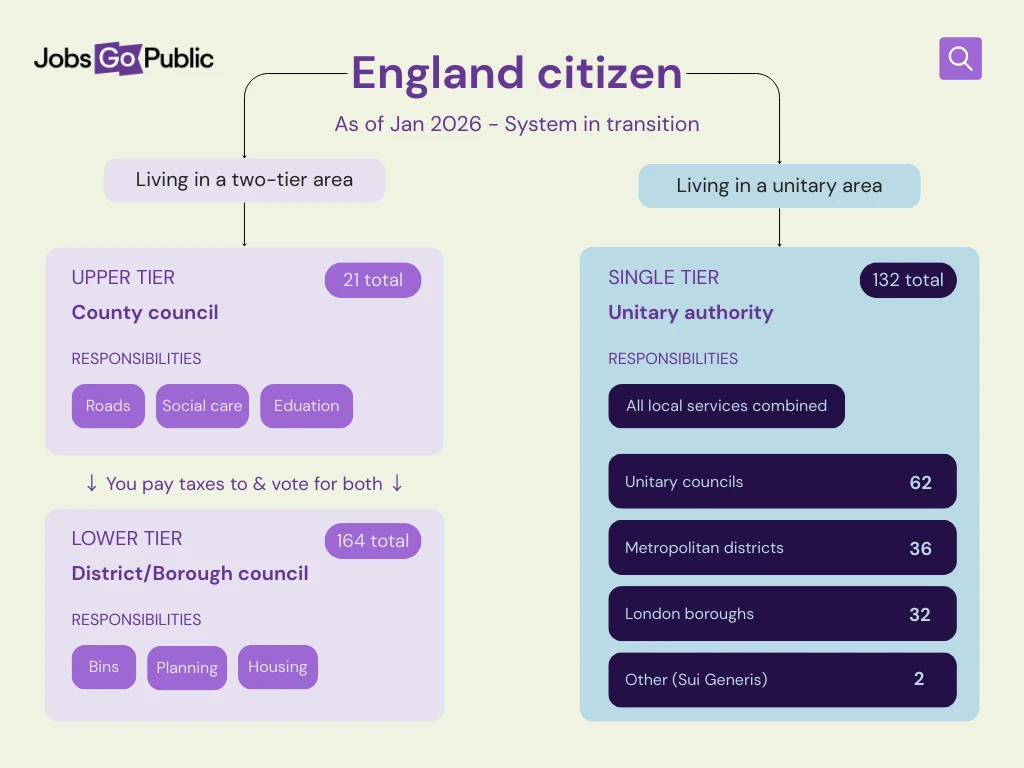
Two-tier local government structures can be confusing. Residents’ council taxes go to both tiers of council, and you vote for elected representatives at both levels. County councils and district councils also provide different public services across the same locations. This can make it unclear who is responsible for what.
On the other hand, unitary councils are single-tier authorities. These authorities are responsible for carrying out all the services in the local area.
The LGR project set out to replace every two-tier council area in England with unitary councils, originally by April 2028. That date now only applies to Surrey, which goes live in April 2027, with dates for everywhere else depending on the government’s review. The main goal behind the programme is to improve service delivery through a simpler council structure.
The list of areas which will be affected by LGR includes:
• Cambridgeshire & Peterborough
• Derbyshire
• Devon
• East and West Sussex
• Essex
• Gloucestershire
• Hampshire
• Hertfordshire
• Kent
• Lancashire
• Leicestershire
• Lincolnshire
• Norfolk
• Nottinghamshire
• Oxfordshire
• Staffordshire & Stoke-on-Trent
• Suffolk
• Surrey
• Warwickshire
• West Berkshire
• Worcestershire
If you live in one of these areas your district or borough council will change. However, it is worth noting town and parish councils will stay the same.
Follow updates for your region on our updates by area page.
Are unitary authorities the same thing as combined authorities?No, a unitary council is not the same thing as a combined authority. A unitary council offers all services to residents in its area. In contrast, combined authorities are partnerships. These partnerships consist of two or more councils that pool resources together to solve issues at a regional level. An example of this is the Liverpool City Region Combined Authority, where multiple metropolitan unitary councils work together. |
Unitary vs Two-tier: Why are councils joining together?
We mentioned that the main objective behind LGR is to simplify the council structure in England. But why does the government want to do this?
Some key reasons outlined in the devolution whitepaper include:
1 The current system is inefficient
The government argues that the two-tier system is inefficient because its structure creates waste. Having two layers of government means residents pay for two levels of administration. This includes management staff, HR departments, and IT systems.
2 Public services are fragmented
Councils often struggle to cooperate effectively on service delivery when different organisations handle them. Your local district council may be handling housing, while the county council is running social care. This makes it harder to provide support, like housing, for vulnerable people who also need social care.
Bringing these services under the same roof allows councils to fix problems more effectively. In addition, they can coordinate with bodies such as the police and NHS more easily.
3 Councils are fighting for the same staff and money
Under the current system, councils often compete in the same locations for talent. This drives up the cost of recruitment, while also leaving gaps in the workforce.
Councils in the two-tier system also spend a lot of time bidding against each other for funding. An example of this includes the Levelling Up Fund for local infrastructure.
All the above factors feed into strain on the local government sector, stretching budgets and confusing residents. LGR aims to reduce these issues and modernise an outdated structure to provide better services to English citizens.
So what do the benefits of this look like to residents in practice?
What is devolution?You may have heard news publications mention LGR as part of the government’s devolution programme. Devolution refers to the process of transferring power and money from the national government to local government. Residents of Wales, Scotland, and Northern Ireland may be familiar with this term. This is because each country has its own elected body that makes laws for local issues. LGR aims to give new unitary authorities more power. This will help them make decisions at a local level and provide more funding for the services they deliver. |
Local government reorganisation benefits: Saving £700 million a year
What exactly are the benefits to people living in the counties affected by LGR of going through this programme?
Here’s a summary of some of the long term gains of LGR:
Massive savings for taxpayers
LGR will initially involve some investment to carry out. However, PwC estimates the new structure will save British taxpayers about £700 million each year through greater efficiency.
Improved transparency and accountability
The more simplified system will reduce the number of politicians required to deliver council functions. This will lead to more clarity as to who is making decisions and is responsible for delivering services.
More power given to local communities
Local Government Reorganisation (LGR) is the first step in the government’s plan to move power away from London. By creating stronger "unitary" councils, your local area becomes better at handling its own money and decisions.
In most areas, these new councils will join a Mayoral Strategic Authority. This is a regional group led by an elected Mayor who focuses on "big picture" goals like creating jobs across the whole region. To keep things moving, these groups will use a majority voting system. This prevents a single council from being able to "block" important plans that would benefit the entire region.
For those working in local government, LGR also brings significant changes to how councils operate as employers:
Making local government a more modern workplace
Reorganisation creates larger, more stable councils that offer better security and clearer career paths for staff. By combining smaller teams into one organisation, you can gain specialised training. This also creates more chances for internal promotions that smaller councils cannot offer.
You will also see less "red tape," as the government is removing the need for central officials to sign off on everyday local decisions. Ultimately, this project aims to make local government a modern, supportive workplace that protects your safety and values your expertise.
More investment in the council workforce
Joining councils together ends competition between local government employers for the same pool of local talent.
This will make it easier and cheaper to fill vacancies by reducing costly "recruitment wastage." They will do this by removing the need for several management teams, as these teams currently do the same jobs in different offices.
Employers also get long-term financial stability with multi-year funding plans. This lets councils invest in their workforce instead of just managing year by year. The simpler structure will make organisations more resilient. They'll be able to handle financial shocks better and provide higher-quality services.
What does LGR mean for council jobs?
Find out how local government reorganisation affects your career in our breakdown of jobs during LGR.
The LGR timeline, from “shadow councils” to “vesting day”
What’s the timeline for local government reorganisation to take place?
The national government published its white paper on the LGR programme in December 2024. Since then, every two-tier area has submitted proposals, consultations have run, and the government announced decisions for 18 areas during 2026.
In September 2026, the programme changed course. The government withdrew four of its decisions and paused the rest while it reviews the whole programme, so there is currently no confirmed end date for most areas. Surrey is the exception: it was excluded from the review and its two new councils launch on 1 April 2027.
Where reorganisation proceeds, the key stages are as follows. Surrey has already been through the first two:
Shadow elections: Residents elect new councillors to a “shadow authority” roughly one year before the old councils close. Surrey held its shadow elections in May 2026. The shadow elections planned for May 2027 in other areas were cancelled when the review was announced.
The shadow council phase: For about 12 months, these shadow councils act as temporary bodies. They operate alongside existing councils to hire senior staff, set the first budget, and design new service plans. Surrey’s shadow councils are doing exactly this now.
Vesting day: The official “go-live” date when the old district and county councils stop operating, and the new unitary authorities take over full responsibility for services, staff, and assets. Surrey’s vesting day is 1 April 2027. For every other area, a vesting day would only be set if and when reorganisation proceeds after the review.
Want to stay up to date with the latest developments in the LGR timeline?
Check out our timeline of local government reorganisation updates here.
What’s next? Stay informed on LGR
Local Government Reorganisation is more than just a name change. It’s a fundamental shift in how councils serve your community and spend your taxes.
Whatever the review concludes for your area, there will be opportunities to have your say, and we’ll keep every page of this hub updated as the picture develops.
For more resources on LGR, visit our local government reorganisation hub.
Click here to explore the LGR Information Hub for more guides, timelines, and FAQs
Written by Jobs Go Public
Jobs Go Public has worked with local authorities since 1999, helping connect people with purposeful careers. We have over 25 years of experience working with local government. We understand the workforce and its hiring challenges well.
Last updated: 09/10/2026